
How Mehmed II Transformed Constantinople into an Ottoman Capital
When Sultan Mehmed II captured Constantinople on 29 May 1453, he gained control of one of the most historically significant cities in the world. However, conquering the former Byzantine capital was only the beginning of his ambitions. To establish a lasting imperial centre, Mehmed needed to restore its economy, attract inhabitants, develop public institutions and create an urban landscape that reflected the authority of the Ottoman dynasty.
The transformation of Constantinople into an Ottoman capital was a gradual process extending across the second half of the fifteenth century. Mehmed II, known as Fatih Sultan Mehmed or Mehmed the Conqueror, encouraged migration, sponsored monumental architecture, reorganised commercial spaces and established educational and charitable institutions. He also adapted selected Byzantine buildings and symbols to serve the needs of his new imperial order.
These changes were practical as well as political. A successful capital required markets, skilled workers, administrative offices, religious institutions and a population large enough to sustain urban life. At the same time, its buildings and ceremonies communicated the sultan’s claim to imperial authority.
The result was not the complete disappearance of Byzantine Constantinople. Instead, the city developed through a complex combination of destruction, continuity, adaptation and new construction. Understanding this process reveals how Mehmed II turned a conquered city into the foundation of a powerful Ottoman empire.
1. Why Mehmed II Wanted Constantinople as His Capital
Constantinople occupied an exceptional geographical position between Europe and Asia. Situated beside the Bosporus, it connected maritime routes between the Black Sea and the Mediterranean and offered access to important commercial networks.
For centuries, the city had served as the capital of the Eastern Roman, or Byzantine, Empire. Its imperial monuments, churches, defensive walls and historic associations gave it enormous political and symbolic importance.
By the fifteenth century, however, the Byzantine Empire had lost most of its former territory. Repeated conflicts, financial difficulties and the Latin conquest of 1204 had weakened the state. When Mehmed captured the city, its population and economy were far smaller than during the empire’s strongest periods.
For the Ottoman sultan, these weaknesses presented both a challenge and an opportunity. Constantinople needed rebuilding, but its location and historical prestige made it an exceptional foundation for a new imperial capital.
Mehmed’s ambitions went beyond acquiring a strategically valuable city. He sought to establish his dynasty as the centre of a broader imperial order, drawing on Ottoman political traditions while selectively appropriating the prestige associated with Byzantine and Roman sovereignty.
For more background on the ruler and his ambitions, read our companion article, Mehmed II: The Man Behind the Conquest.
2. Rebuilding a City Damaged by Centuries of Conflict
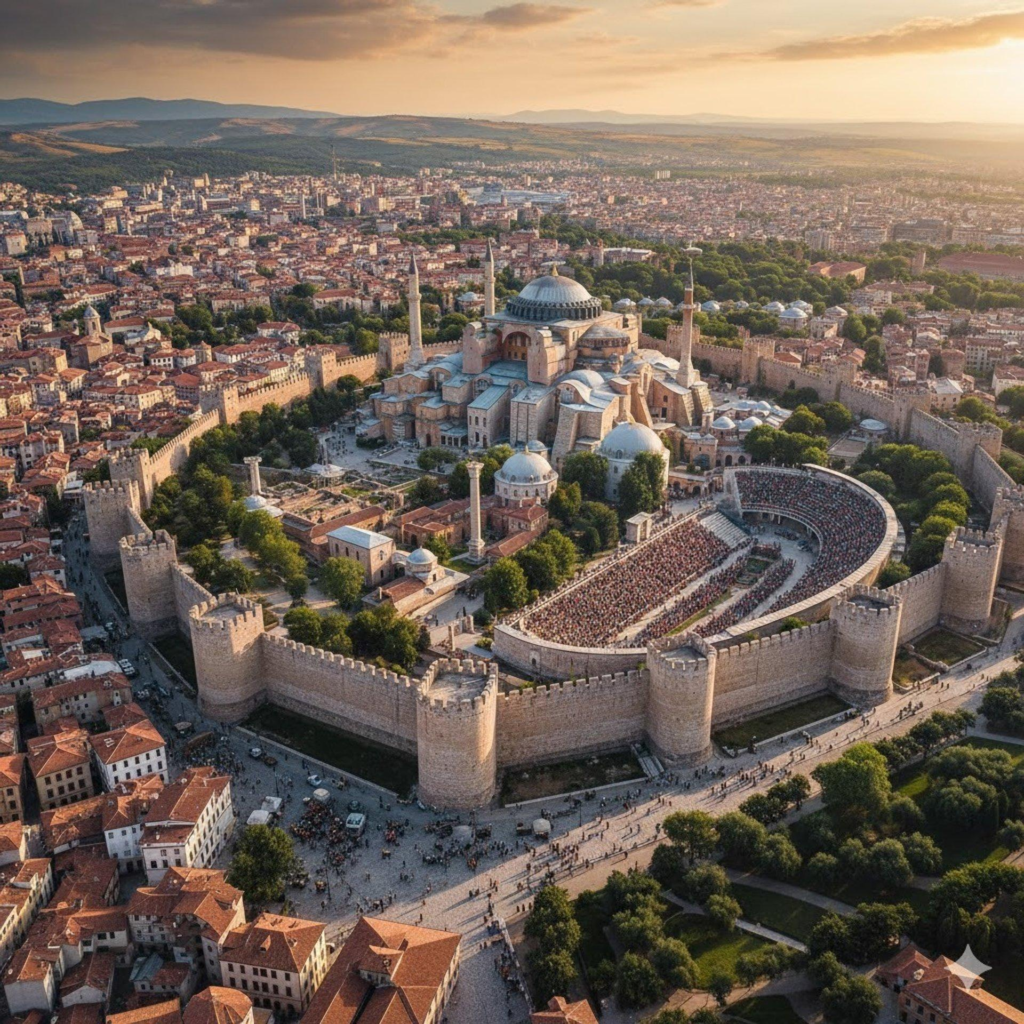
Constantinople was not an untouched prize when the Ottomans entered it. The city had endured the catastrophic events of 1204, subsequent warfare, declining imperial resources and repeated Ottoman pressure during the decades before 1453.
Although many historic structures survived, entire areas required attention. Restoring the city meant more than constructing new monuments: it required repairing infrastructure, reviving commercial activity and making neighbourhoods attractive and productive again.
From military victory to urban reconstruction
Mehmed II’s government began adapting the city to its new political circumstances. Important buildings were assigned new functions, while the construction of palaces, mosques, markets and public institutions gradually changed its urban character.
The process did not follow a single, perfectly coordinated master plan. Scholars have shown that projects developed over several decades, and the sultan’s priorities evolved as his imperial ambitions became clearer.
Some decisions were made soon after the conquest, while other major developments took shape during the 1460s and 1470s. The result was a changing capital whose physical landscape increasingly reflected Ottoman political authority.
Repairing and reusing existing structures
Existing Byzantine infrastructure remained valuable. Defensive walls, roads, cisterns, harbours and other inherited structures continued to influence the city’s development.
Some religious buildings were converted to new purposes, while other monuments survived as reminders of the city’s earlier history. Reusing existing structures could be practical, but it also carried symbolic meaning: the new government was establishing control over spaces that had previously represented Byzantine sovereignty.
This combination of continuity and change became one of the defining features of Ottoman Constantinople.
3. Resettlement: Bringing People Back to the Capital
One of Mehmed II’s most important challenges was population recovery. A capital could not function effectively without merchants, artisans, builders, scholars, administrators and ordinary residents.
Constantinople’s population had declined considerably before the conquest. The exact figures remain uncertain, but historians agree that the city was far less densely populated than it had been during earlier periods of Byzantine power.
Mehmed therefore encouraged migration and directed population transfers as part of his rebuilding programme.
Who settled in Ottoman Constantinople?
The population movements involved people from different parts of the Ottoman territories and beyond. Muslims, Orthodox Christians, Armenians, Jews and other communities contributed to the city’s developing social and economic life, although their experiences varied.
Some people moved because of commercial opportunities, employment, family connections or the advantages of living in an imperial capital. Others were relocated through state-directed or compulsory measures.
This distinction is essential. Ottoman resettlement was not always voluntary, and the reconstruction of the city involved coercive policies as well as incentives.
The government sought to establish a population capable of sustaining markets, workshops, religious institutions and public services. Bringing people into underpopulated areas could also help revive neighbourhoods and increase economic productivity.
Population growth and its limitations
Research on late fifteenth-century Istanbul describes a substantial increase in population after the conquest. Estimates vary according to the sources and methods used, so individual figures should be treated as approximations rather than exact census totals.
The important historical point is that Constantinople became more densely populated and economically active over time. Migration contributed to this recovery, but the process also depended on commercial opportunities, public construction and the establishment of institutions that supported daily life.
The emerging capital was increasingly diverse. Its population reflected the wide geographical reach of the Ottoman state and the practical demands of governing a large imperial city.
4. Hagia Sophia: Reusing a Symbol of Byzantine Power
Few buildings demonstrate the political significance of the conquest more clearly than Hagia Sophia.
Built under Emperor Justinian I and inaugurated in 537, the church had served as the principal cathedral of Constantinople and one of the most important monuments of Orthodox Christianity.
After the Ottoman conquest, Mehmed II converted Hagia Sophia into a mosque. The decision established a new religious function for a building closely associated with Byzantine emperors and the Orthodox Church.
Why the conversion mattered
The conversion was both practical and symbolic. It provided a major place of Muslim worship while demonstrating the transfer of sovereignty from the Byzantine emperor to the Ottoman sultan.
Rather than demolishing the structure, the Ottomans retained its monumental architecture and adapted it to its new use. Over time, Islamic furnishings and architectural additions became part of the building’s evolving appearance.
The result was a layered monument. Its architectural form preserved evidence of Byzantine engineering and artistic achievement, while its Ottoman history reflected the religious and political transformation of the city.
Hagia Sophia was not the only Byzantine building to survive or acquire a new function, but its size and prestige made it particularly important in the symbolic reorganisation of Constantinople.
5. The Fatih Mosque Complex: A New Centre of Imperial Life
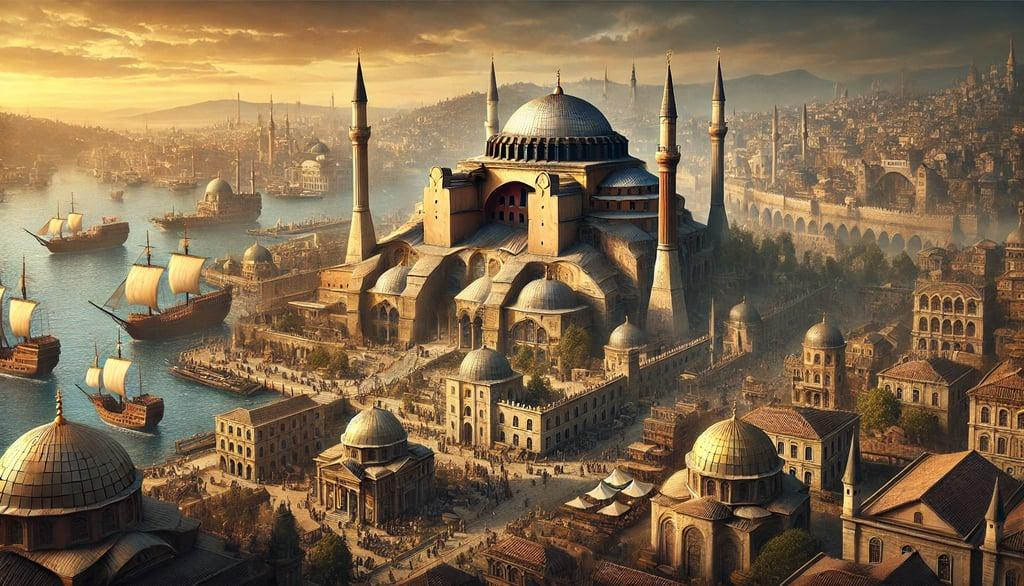
Mehmed II’s most significant architectural project was the Fatih Mosque complex, known as the Fatih Külliyesi.
Construction began in the 1460s, and the complex developed into a major religious, educational and charitable institution. It occupied the site of the former Church of the Holy Apostles, an important Byzantine church associated with imperial burials.
Choosing this location was significant. The new complex placed an Ottoman imperial foundation within the historic urban landscape of Byzantine Constantinople.
What was a külliye?
A külliye was a complex of interconnected institutions organised around a major religious foundation. Depending on the project, it could include a mosque, schools, a hospital, a soup kitchen, accommodation, a bathhouse and other facilities.
These institutions addressed several needs simultaneously. The mosque provided a place for communal worship, educational facilities supported scholarship, and charitable services helped feed or accommodate people in need.
The complex therefore served as more than an architectural landmark. It was an organised centre of social, religious and educational life.
Education and the imperial establishment
The Fatih complex included the Semaniye madrasas, which became important institutions for advanced learning. They helped train scholars who could contribute to religious, legal and administrative life.
The establishment of these institutions also strengthened the sultan’s relationship with the scholarly establishment. Educational appointments and institutional hierarchies became part of the wider organisation of imperial authority.
Mehmed’s architectural patronage thus supported both the city’s social development and the central government’s ambitions.
A note about the surviving building
The original Fatih Mosque suffered severe damage in the earthquake of 1766 and was subsequently rebuilt. The complex visible today therefore does not preserve every element of Mehmed II’s original construction unchanged.
Its location and institutional history nevertheless remain important evidence of the sultan’s programme for transforming Constantinople.
6. Markets, Trade and the Economic Recovery of the Capital
A major imperial capital required more than palaces and mosques. It needed commercial infrastructure capable of supplying its population and supporting government revenue.
Constantinople’s location made it well suited to trade. Its harbours connected the Black Sea with the Mediterranean, while overland routes linked it to the Balkans and Anatolia.
Developing a commercial centre
Mehmed II supported the development of markets and commercial facilities intended to encourage economic recovery. The rebuilding of commercial areas helped attract merchants and craftspeople while providing places for goods to be stored, exchanged and sold.
The Grand Bazaar’s historical development belongs to this broader process of expanding the city’s commercial infrastructure. The earliest commercial structures associated with the Ottoman capital emerged during the later fifteenth century, while the wider bazaar complex grew and changed over subsequent generations.
It would be misleading to imagine the modern Grand Bazaar appearing fully formed immediately after the conquest. Its present scale and organisation reflect a much longer history.
Merchants and economic diversity
Trade brought together merchants from different parts of the Ottoman Empire and the wider Mediterranean world. Their networks connected the capital with agricultural regions, manufacturing centres and maritime ports.
The government benefited from a productive commercial environment through taxation, employment and the availability of supplies. Merchants, meanwhile, benefited from access to a major urban market and connections with the imperial administration.
Economic recovery was gradual and uneven, but it helped transform Constantinople from a weakened former imperial capital into an increasingly important centre of Ottoman commerce.
7. Palaces and the New Language of Imperial Authority
Architecture also helped Mehmed II establish a new style of rulership.
The sultan needed a court capable of managing a growing empire, receiving diplomatic visitors, coordinating government and presenting an image of imperial authority.
The Old Palace and Topkapı Palace
After the conquest, Mehmed established a palace on the site associated with what later became known as the Old Palace. He subsequently initiated the construction of the palace complex that developed into Topkapı Palace, on a prominent position overlooking the Bosporus and Golden Horn.
The new palace was not simply a residence. It provided spaces for court life, administration, ceremony and the management of the imperial household.
Its location linked the Ottoman court to the city’s strategic geography and historic centre. Its organisation also helped establish a more formal distinction between the sultan and the wider population.
Topkapı’s buildings and layout continued to develop under later rulers, so the palace visible today reflects several periods of construction rather than a single completed design from Mehmed’s lifetime.
Court ceremony and political culture
The organisation of the court formed part of Mehmed’s broader effort to strengthen the authority of the sultan. Ceremonies, official titles, appointments and controlled access to the ruler helped define the hierarchy of imperial government.
These practices drew upon multiple traditions, including Ottoman, Islamic, Persianate and Byzantine political cultures. Mehmed’s court was therefore not simply a continuation of one earlier model; it represented a selective combination of influences adapted to his ambitions.
Architecture gave these political arrangements a physical setting, making the palace a central institution in the developing Ottoman capital.
8. Religious Diversity and the Organisation of Urban Communities
The Ottoman conquest did not eliminate the city’s Christian population. Constantinople continued to contain communities with different religious traditions, although their positions changed under the new political order.
The Orthodox Patriarchate
After the conquest, Mehmed II appointed Gennadios Scholarios as Orthodox patriarch. This helped establish a working relationship between the Ottoman government and the Orthodox Church.
The patriarchate continued to provide religious leadership and serve as an important institution for Orthodox Christians. Its position, however, existed within a hierarchy dominated by the Ottoman state.
These arrangements were not equivalent to modern religious equality. Non-Muslim communities faced distinct legal obligations and restrictions, and their experiences varied across time and social circumstances.
Nevertheless, the continuation of Orthodox institutions was an important part of the city’s post-conquest development.
Muslim institutions and new neighbourhoods
Mosques, madrasas, charitable foundations and other institutions contributed to the growth of Muslim urban life. Major religious complexes often helped establish or strengthen surrounding neighbourhoods by attracting residents, students, workers and merchants.
The city gradually developed a distinctive Ottoman urban character, but this did not mean that all communities lived in identical circumstances or that the process was uniform across every district.
Constantinople’s cultural life emerged from the interaction of government policy, religious institutions, migration and commercial activity.
9. Art, Scholarship and Cultural Life
Mehmed II’s vision of Constantinople extended beyond administration and construction. He wanted the capital to be a centre of learning, artistic patronage and imperial prestige.
The court attracted scholars and artists from different cultural backgrounds. Mehmed showed interest in classical history and supported intellectual activity, while his patronage connected the Ottoman court with artistic and scholarly traditions from the Islamic world and Renaissance Europe.
Scholarship and education
The Semaniye madrasas and other educational institutions helped establish Constantinople as a centre of advanced Islamic learning.
Scholars contributed to religious studies, law and the intellectual life of the court. Their work also supported the development of a more structured relationship between learned officials and the imperial administration.
This process was gradual. Scholars retained their own intellectual interests and social relationships, and the sultan’s efforts to organise the learned establishment did not eliminate every independent source of influence.
Art and international connections
Mehmed’s court engaged with a broad cultural world. His patronage extended to artists and intellectuals associated with different traditions, including the Italian Renaissance and Greek scholarship.
The Venetian painter Gentile Bellini’s portrait of Mehmed is a well-known example of these connections. It demonstrates how artistic patronage could communicate prestige and place the Ottoman ruler within a wider Mediterranean political and cultural environment.
The capital’s cultural life therefore developed through both imperial direction and exchange with other societies.
10. Did Mehmed II Create a Completely New City?
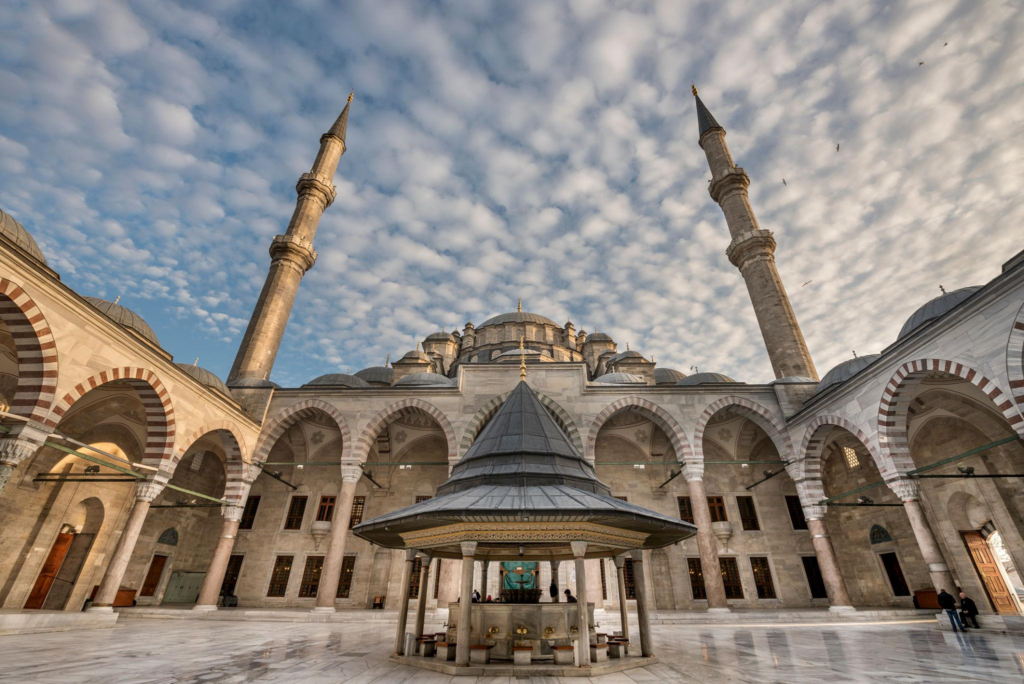
It is tempting to describe Ottoman Constantinople as an entirely new city built after 1453. Such a description overlooks the importance of the inherited urban landscape.
The city retained roads, walls, cisterns, harbours, monuments and public spaces that had shaped its development for centuries. Some buildings were repurposed, while others continued to serve their earlier functions or were modified over time.
The Hippodrome, for example, remained an important element of the city’s urban geography. Its use changed, but the site continued to influence the organisation of public space.
At the same time, new mosques, palaces, markets and educational complexes transformed the city’s appearance and social organisation.
The more accurate interpretation is that Mehmed II initiated a profound reorganisation of Constantinople. The city became Ottoman through a combination of new construction, selective adaptation, population movement and changing political institutions.
11. The Limits of Mehmed II’s Urban Programme
Although Mehmed’s capital-building programme was ambitious, it did not achieve every objective immediately.
Construction required funding, materials, skilled labour and sustained administrative attention. Population recovery depended on migration and economic opportunity, while commercial growth required stable networks and functioning markets.
Some projects took years to complete, and others continued to evolve after Mehmed’s death in 1481. Later Ottoman rulers expanded the capital’s monumental architecture and changed its urban landscape further.
The transformation was also shaped by coercion. Forced relocation, the consequences of conquest and the unequal status of religious communities were part of the city’s history. An account that focuses only on architectural achievement would overlook the human costs of the process.
Mehmed’s legacy is therefore best understood through both his accomplishments and their limitations. He created important foundations for Ottoman Istanbul, but the capital’s development remained an ongoing process rather than a finished project.
12. The Lasting Legacy of Mehmed II’s Capital
Mehmed II transformed Constantinople by connecting reconstruction with the political, economic and cultural needs of an expanding empire.
His government encouraged resettlement, developed commercial spaces, supported monumental architecture and established institutions for education, charity and administration. The conversion of Hagia Sophia and the construction of the Fatih Mosque complex expressed the new political order, while the development of palaces and court institutions strengthened the sultan’s authority.
Yet the city also retained important elements of its Byzantine inheritance. Its geography, infrastructure and monuments continued to shape daily life and political symbolism.
Later Ottoman rulers built upon the foundations established during Mehmed’s reign, adding new architectural complexes and expanding the capital’s institutions. The Istanbul of subsequent centuries was therefore the result of several generations of development, beginning with the transformation initiated after 1453.
Mehmed’s achievement was not simply that he captured Constantinople. It was that he helped make the city a lasting centre of Ottoman imperial life.
For another perspective on the city’s transformation, read Constantinople Before and After 1453. To explore the military events that made this transformation possible, visit The Conquest of Constantinople in 1453: The Complete History.
Frequently Asked Questions
How did Mehmed II transform Constantinople after 1453?
Mehmed II encouraged population resettlement, supported the recovery of commercial activity, converted Hagia Sophia into a mosque, initiated major palace and mosque projects, and established educational and charitable institutions. These measures gradually reshaped the city into an Ottoman imperial capital.
Why did Mehmed II want Constantinople as his capital?
The city occupied a strategic position between Europe and Asia and controlled important maritime connections. Its historical prestige and urban infrastructure also made it a powerful centre from which the Ottoman sultan could govern and express imperial authority.
What was the Fatih Mosque complex?
The Fatih Mosque complex, or Fatih Külliyesi, was a major religious, educational and charitable foundation established under Mehmed II. It included the mosque and associated institutions, such as madrasas and facilities for social welfare. It became an important model for Ottoman urban development.
Did Mehmed II force people to move to Constantinople?
Yes. Historical research indicates that the Ottoman government used compulsory resettlement alongside voluntary migration and incentives. These population movements helped rebuild the capital, but they also disrupted the lives of people transferred from other regions.
What happened to Hagia Sophia after the conquest?
Mehmed II converted Hagia Sophia from an Orthodox cathedral into a mosque. The structure was retained and adapted rather than demolished, making it an important example of how Ottoman rulers reused an inherited Byzantine monument.
How did Mehmed II support education?
He established and supported educational institutions, most notably the madrasas associated with the Fatih Mosque complex. These institutions helped train scholars and strengthened the capital’s role as a centre of Islamic learning.
Did Constantinople become an Ottoman city immediately in 1453?
Political sovereignty changed immediately after the conquest, but the city’s physical, demographic and institutional transformation took decades. Construction, migration, commercial recovery and administrative development continued throughout Mehmed II’s reign and under later sultans.
Was Topkapı Palace built entirely during Mehmed II’s lifetime?
Mehmed II initiated the palace complex that developed into Topkapı Palace. However, the palace was expanded and altered under later rulers, so its present form reflects several centuries of Ottoman history.
What is the difference between Constantinople and Istanbul in this historical period?
Constantinople refers to the historic city under Byzantine rule and remained in use in various contexts after the conquest. Ottoman forms of the name included Kostantiniyye, while Istanbul also developed through historical usage. The city’s naming practices changed over time rather than through one universally adopted renaming in 1453.
Historical Sources and Further Reading
- Çiğdem Kafescioğlu, Constantinopolis/Istanbul: Cultural Encounter, Imperial Vision, and the Construction of the Ottoman Capital. Pennsylvania State University Press. A major study of urban reconstruction, imperial symbolism, population and cultural life after the conquest. Read the book overview.
- Abdurrahman Atçıl, “Scholars in Mehmed II’s Nascent Imperial Bureaucracy (1453–1481).” Cambridge University Press. Examines the relationship between scholars, educational institutions and the developing Ottoman administration. Read the chapter summary.
- Kayoko Hayashi, “Compilation Process of Manuscripts called Vakfiye of Sultan Mehmed the Conqueror.” Annals of the Japan Association for Middle East Studies. Examines endowment documents relevant to the reconstruction of Istanbul and the chronology of Mehmed’s foundations. Read the research record.
- R. Strootman, “From Hippodromos to Atmeydanı: Continuity and Change in the Urban Layout of Constantinople after the Ottoman Conquest.” Brill, 2024. Explores the changing use and symbolism of public space after 1453. Read the academic chapter record.
- Society of Architectural Historians, “Creating an Ottoman Capital: Istanbul in the Late Fifteenth Century.” An accessible overview of the gradual reconstruction of the city and the role of major architectural projects. Read the article.
- T.C. Fatih Municipality, “Selatin Mosques in Fatih.” Institutional background on the Fatih Mosque complex and its educational and charitable facilities. Read the municipal history.
This article is an original historical synthesis informed by published scholarly research and institutional sources. Dates, population estimates and interpretations of urban policy should be read in light of the limitations of surviving historical records.